Replay Fields of Dreams


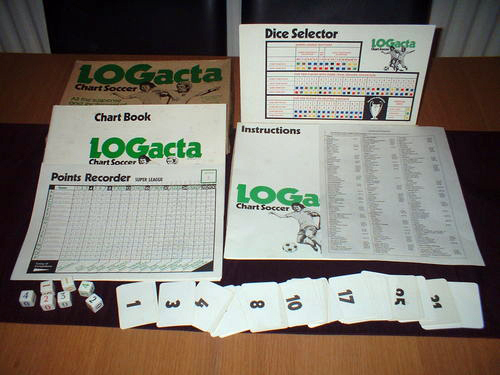
In its original form, Logacta was sold as a small white box
containing numerous printed grids and instructions, cards and
seven dice with different coloured numbers on. On an eBay
auction several years ago was someone selling all the original
printed materials scanned in and saved as JPEG files onto a
recordable CD along with a description of how each of the die
were configured. In essence, this was a do-it-yourself version
of Logacta but no less intriguing.
Here is an overview of how to play Logacta
Tabletop
‘Chart
Soccer’.
Super League

First of all, you’re invited to
create a 16-team Super League made up of teams from anywhere in
the UK. Because Logacta was made back in 1976, I tried to
include teams that were among the best around back then. Of the
14 English teams I chose, all but one - my team, West Ham - were
playing in the First Division, the other two being Celtic and
Rangers.
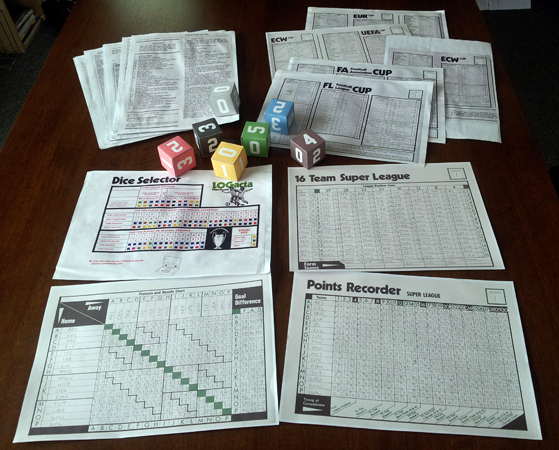
Having filled their names in on the
Fixtures and Results (F&R) Chart and the Super League Points
Recorder, I was ready to start my new league championship
competition. A glance at the F&R Chart revealed that each square
in the fixture grid had a number relating to each of the 30
gameweeks. I looked for all the squares numbered ‘1’ and
prepared myself to fill in some scores.
The dice
So how do you create scores in Logacta? Easy - by using two of
seven coloured dice. Each one contains its own unique set of
numbers which, when two are rolled, determine the score of every
match. The numbers are weighted for certain types of team; for
instance the blue die has slightly higher numbers than the red
die, thereby making the former more suitable for the team with
home advantage than the latter.
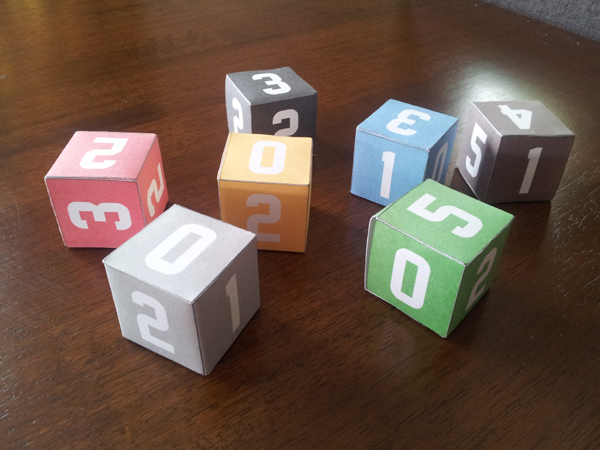
I decided to make my own using the number sets specified. They look OK, but to be honest they were rather fiddly and time-consuming to make and if the thought of playing with card, scissors and a Pritt Stick doesn’t appeal, you might want to use another system instead.
I personally bought a set
of blank dice in seven different suitable colours, made stickers
for the numbers and affixed to the blank dice which is much
better - JOHN
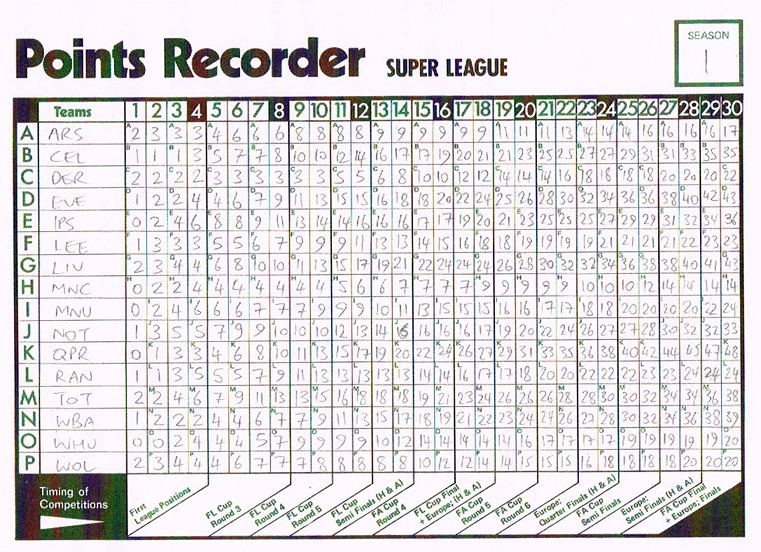
For the first four weeks of the Super League, only the red and
blue dice are used to keep things nice and simple. With that in
mind, I raced ahead and recorded the scores and points totals
for the first four gameweeks. It’s fair to say that some teams
realistically mirrored their 1976 vintage while others didn't.
After Week 4, Ipswich, Man United and Tottenham shared the lead
with six points from a possible eight (two points for a win,
remember) while at the bottom were Derby and West Bromwich
Albion on two points.

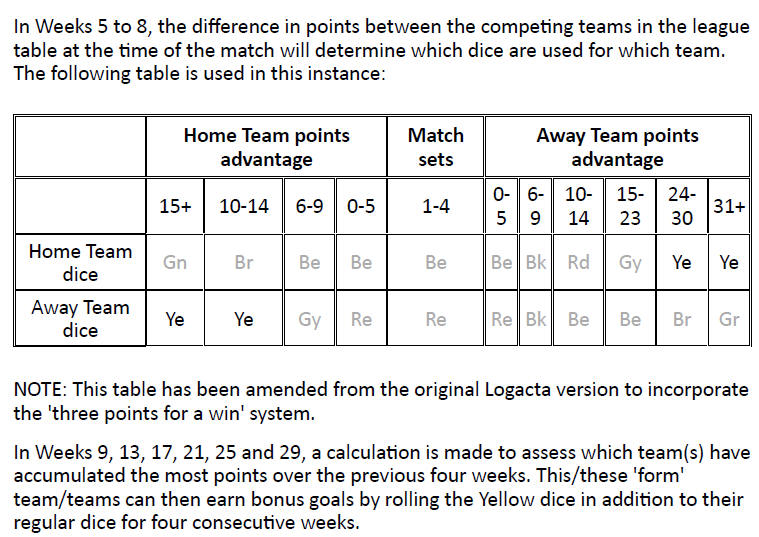
For Gameweeks 5 to 8, the choice of
dice used for both teams was made differently. Before every
game, I had to work out the difference in points between the two
competing teams by looking at the Super League Points Recorder.
Once that was done, I had to cross-reference a sheet called the
Dice Selector to find out which colours the dice should be.
Here’s an example: If Celtic had 10 points and Wolves had 5
points at the point when they played, the Dice Selector would
tell you that you should roll the blue dice for Celtic and the
grey dice for Wolves. As with all dice permutations, the final
result should go in favour of the team with more points, but an
upset is always possible as in real football.
The League Cup

On I went, rolling dice and
scribbling numbers onto my sheets of paper until Gameweek 8 was
completed. With Tottenham now clear at the top of the table, I
noticed my Points Recorder chart telling me it was time for
League Cup Round 3.
For this and all the Cup competitions, you’re allowed a free
choice of any teams to compete as long as you have the right
amount of each type. For instance, in the opening round of the
League Cup, you’re allowed 11 teams from Division One, 10 from
Division Two, 6 from Division Three and 4 from Division Four
along with the current holders. Luckily a handy sheet is
provided that lists who was in which division and who had won
what the previous season.
Having chosen my teams, I then had to make the draw for Round
Three. The original Logacta kit had 32 numbered cards which
could be used in the absence of the Football League’s velvet bag
of wooden balls.
For all League Cup games, the Dice Selector works on the basis
of which divisions the two competing teams are in. So for
instance if Nottingham Forest (1) were playing Southend United
(3), you’d know that Forest would use the brown dice and
Southend would use the yellow one.
So off I went again on my dice rolling exploits, but this being
a Cup competition, I had to follow the right procedure for drawn
games. A replay was sometimes required and even Extra Time. For
that, I had to roll the yellow dice to determine any extra
decisive goals. Exciting stuff. Well, kind of.
The Form die
With League Cup Round 3 done and dusted, it was back to the
Super League but now I had to roll a ‘Form’ die during every
gameweek. The principle was thus; for every four-week block of
matches, the team(s) that scores the most points is entitled to
potentially score extra goals in the next four-week block by
rolling the extra yellow ‘Form’ die. In other words, the better
your form, the better your form will probably be in successive
weeks.
Tottenham and QPR had scored the most points in Gameweeks 5 to 8
of my league, so they got to roll for more goals with the yellow
die in weeks 9 to 12. For one of them, it was to prove decisive.
The FA Cup, The League Cup Final and Europe
Weeks went by and the Form die was
already helping to sort the league’s high-flyers from its
whipping boys. Just past the mid-way point, Liverpool and QPR
led the table with 24 points from 32 while Derby were at the
other end with just five.
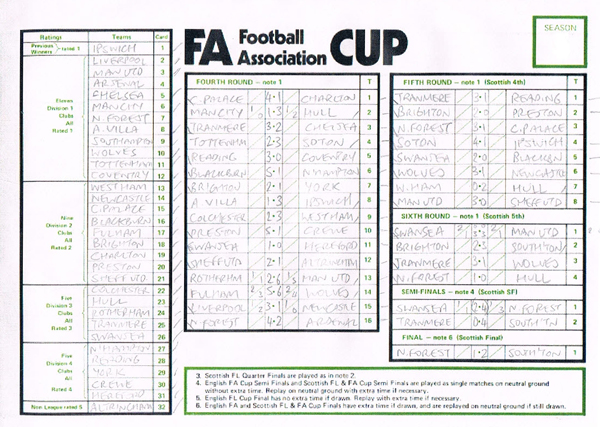
Around the same time, the FA Cup Fourth Round appeared on the
calendar and once again I had to pick and draw the competing
teams. Fun though it is at first to re-enact every draw that
arises, the novelty does start to wear off as you just want to
get on with playing the matches. For all that, however, I did
have the undeniable pleasure of seeing West Ham beat Colchester
3-2, therein justifying my decision to include The Hammers in
every competition possible.
This was borne out when West Ham reached the semi-finals of my
League Cup competition but inexplicably they were beaten 6-5 on
aggregate by Wigan Athletic, then of Division Four. Outraged but
willing to accept the result as it stood, Wigan then went on to
beat Newcastle 2-1 in a replay of the League Cup Final after the
first match was drawn 3-3.
As if that wasn't enough to satiate
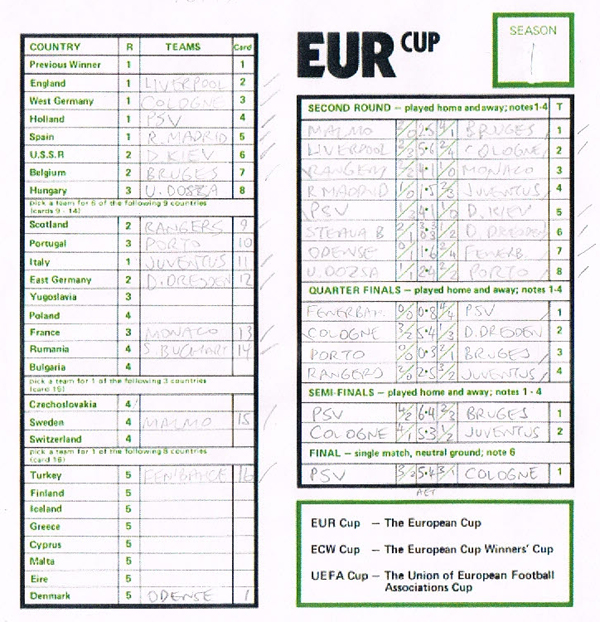
your interest, the three European competitions then arrived hot
on their heels. In drawing up the starting lists for The
European Cup, The European Cup-Winners’ Cup and the UEFA Cup,
one had to observe the ranking system for all possible competing
teams - 1 for the strongest countries down to 5 for the weakest.
These grades would have an effect on which dice were used, but
with Scottish teams ranked the same as those from Russia in the
European Cup and Spanish teams in the Cup-Winners’ Cup, one
could never be quite sure if all was as it should be.
Anyway, the 24 European games were drawn and played and through
completely random misfortune, all my English clubs were
eliminated at the first hurdle. And the late-70’s was supposed
to be a high point for English teams in Europe...
The final push
And so it went on. Blocks of four
Super League games regularly interrupted by successive rounds of
either the FA Cup or the Euro competitions. The suggested tip of
filling in the charts with a pencil so that mistakes could be
rubbed out also proved of great value as my faltering mind
started to make occasional errors in my calculations.
In my Super League, QPR had hit top position in Week 20 and
stayed there right through to the bitter end, winning the title
with three weeks to spare. At the other end of the table,
however, Manchester City had ‘wooden spoon’ written all over
them from even earlier in the season and were easily the worst
team on form as well as points.
The FA Cup was won by Southampton, 2-1 winners over Nottingham
Forest. Not a bad foresight of the two teams that were to appear
in the real
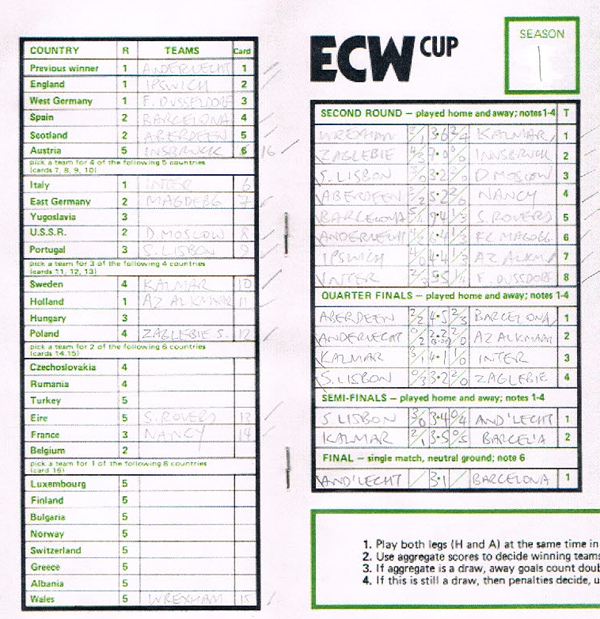
1979 League Cup Final. As for Europe, PSV won the European
Cup Final 5-4 over Cologne after extra time, Anderlecht beat
Barcelona 3-1 in the Cup-Winners’ Cup and Stuttgart beat Torpedo
Moscow 4-3 in the UEFA Cup Final.
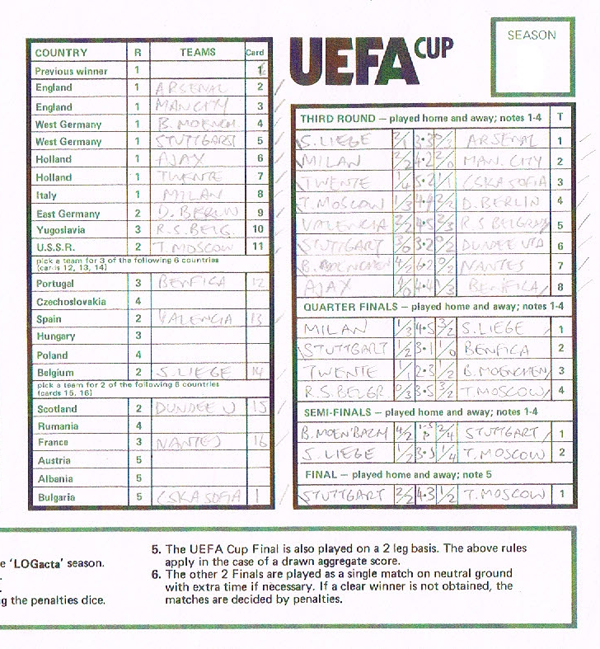
So that was it - except it wasn’t,
according to the game’s manufacturer. Logacta implores you to
play season after season, applying promotion and relegation to
the Super Leagues and giving byes to previous Cup champions as
you go. There were also charts that enable you to play out your
own version of the European Championships or even the World Cup.
I’d enjoyed the process of understanding the complex logic of
Logacta, not to mention the way one observes the unfolding
development of various League and Cup competitions.